Your website is not just an online brochure or digital business card—it is your most powerful, non-stop 24/7 sales engine. When engineered properly, it educates prospects, removes objections, qualifies buyer intent, and consistently delivers high-ticket inquiries directly into your pipeline.
Yet, countless ambitious business owners invest thousands of dollars into website development, watch traffic trickle in, and wonder: "Why isn't our phone ringing? Why aren't inquiries converting?"
In more than 85% of cases, the problem isn't your product quality, your pricing, or your advertising budget. The real culprit is a series of silent, structural conversion roadblocks baked directly into your web pages.
Conducting an objective business website audit reveals that most underperforming sites repeat the exact same errors. Below are the 5 critical web design and conversion mistakes killing your business growth, along with concrete, developer-tested fixes you can implement right away.
1. Sluggish Page Speed (The Unforgiving 3-Second Rule)
The Problem
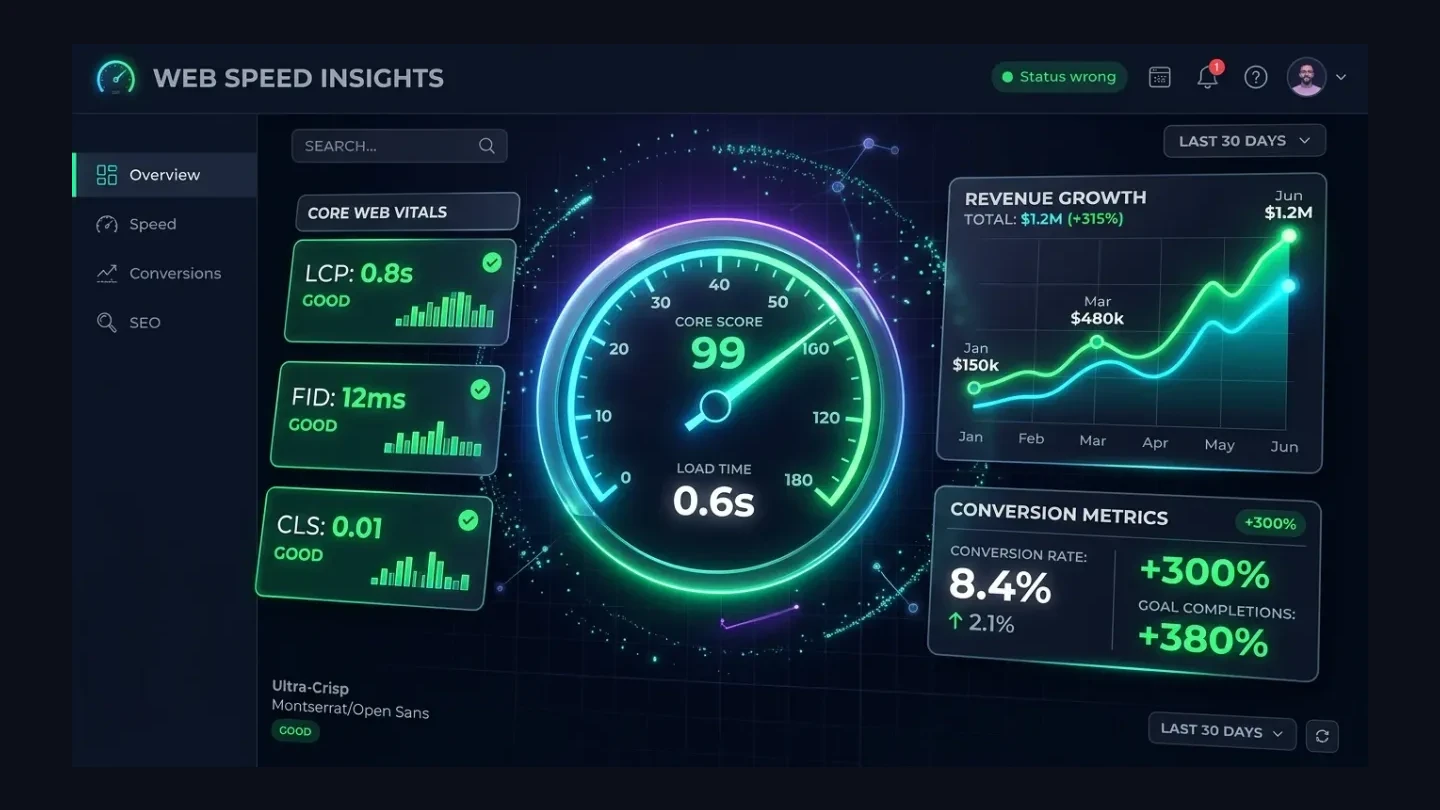
Modern online buyers have zero tolerance for latency. Benchmark research from Google and Akamai shows that if a web page takes longer than 3 seconds to load, over 40% of potential buyers abandon the session immediately and head straight to a competitor.
Sluggish speeds do double damage:
- Destroys Conversion Rates: Every single 1-second delay reduces conversions by roughly 7%. On an e-commerce or B2B site doing $50,000 monthly, a 2-second delay is quietly leaking $7,000+ every month.
- Hurts Google Rankings: Google's algorithm explicitly prioritizes Core Web Vitals (Largest Contentful Paint, Interaction to Next Paint, Cumulative Layout Shift). Heavy, laggy websites get pushed down in search rankings.
💡 Self-Audit Test: Open your smartphone right now, disconnect from office Wi-Fi onto standard cellular data (4G/5G), and open your homepage. Count out loud: "One thousand one, one thousand two, one thousand three." Did your main headline and value proposition load cleanly before three? If not, you are actively losing customers every day.
The Fix
- Eliminate Monolithic Bloat: Move away from bloated page builders (like Divi or heavy Elementor installs with 35+ active plugins) that load megabytes of unused render-blocking JavaScript and CSS.
- Modern Cloud Architecture: Migrate to a lightning-fast custom Next.js web application with automatic image optimization (AVIF/WebP formats), edge caching, and Server-Side Rendering (SSR).
- Asset Optimization: Ensure all hero graphics and product shots are compressed under 150KB and served through a modern Content Delivery Network (CDN) like Cloudflare or AWS CloudFront.
2. Generic "One-Size-Fits-All" Content Without Targeted SEO Positioning
The Problem
Too many corporate websites read like generic Wikipedia entries: "We offer world-class services, innovative end-to-end solutions, and trusted client excellence."
Phrases like that convey zero differentiation. When an international buyer in New York or Dubai lands on your site, they don't want buzzwords—they want to know within 5 seconds: Can you solve my exact problem, in my specific industry, within my timeframe?
Furthermore, building a single generic "Services" page eliminates your ability to rank for high-intent search queries. A visitor searching for "custom tour itinerary management software" or "textile export supplier in South India" will never find a website that only has a vague "Software Development" or "Manufacturing" page.
The Fix
- Build Industry-Specific Landing Pages: If you serve multiple sectors, build dedicated programmatic service pages (e.g., travel agency web development, logistics software, or export web portals).
- Align with High Commercial Intent: Map every page to a distinct search query. Structure metadata, header hierarchy (H1, H2, H3), and schema markup to capture both local buyers and global enterprises.
- Speak Your Buyer's Language: Replace vague corporate jargon with measurable business outcomes (e.g., "Reduce booking turnaround by 65%" instead of "Streamlining your operations").
Need a Website That Converts Visitors into Direct Paying Clients?
Most websites fail to generate sales because they are slow and lack conversion funnels. Joy Digital builds custom, sub-second Next.js web applications with 95+ PageSpeed, built-in SEO, and frictionless 1-click WhatsApp lead captures.
3. Confusing Navigation and Buried Calls-to-Action (CTAs)
The Problem
If a qualified prospect lands on your website and has to hunt through nested dropdown menus just to figure out how to request pricing or schedule a call, you have already lost them.
Common conversion-killing navigation traps include:
- 8 to 10 top-level menu items with zero visual hierarchy.
- Vague button labels like "Submit", "Click Here", or "Learn More".
- Forms hidden three clicks deep behind secondary pages.
- Long, intimidating contact forms demanding 12 different fields before someone can even ask a question.
| User Experience Element | Conversion Killer ❌ | High-Converting Standard ✅ |
|---|---|---|
| Primary Menu | 10+ items, dropdowns inside dropdowns | 4–5 core links with prominent CTA button |
| CTA Button Label | "Click Here", "Submit" | "Get Free Audit", "Schedule Strategy Call" |
| Form Fields | Name, Address, Company Size, Budget, Fax, Message | Name, Email/WhatsApp, Short Project Scope |
| Above-the-Fold | Huge auto-playing slider with zero clear message | Bold value proposition + clear 1-click CTA |
The Fix
- One Primary Goal Per Page: Decide the single desired action for each page. Is it booking a call, downloading a spec sheet, or initiating a WhatsApp inquiry?
- High-Contrast, Sticky CTAs: Place a clear, actionable button in your top navigation header that remains accessible as visitors scroll down long-form content.
- Frictionless Inquiries: Reduce contact forms to 3 or 4 essential fields (Name, Business Email / WhatsApp Number, Project Goal). For high-intent mobile users, integrate a direct WhatsApp Business chat trigger for instant conversations.
4. Relying on Fragile No-Code Site Builders to Scale a Serious Enterprise
The Problem
No-code tools and basic template builders (such as basic Wix or unmaintained WordPress setups) are great for validating a concept in the first 30 days of a startup.
However, as your business grows into six- or seven-figure annual revenue, these platforms rapidly become an operational bottleneck:
- The "Plugin Jenga" Trap: Need multi-currency pricing? Install a plugin. Need lead tracking? Another plugin. Need custom SEO tags? Another plugin. Soon, you have 30 plugins fighting for PHP server memory, causing weekly crashes and slow query performance.
- Security Vulnerabilities: Over 90% of CMS cyber breaches originate through unpatched third-party plugins. A single zero-day exploit can leave your site blacklisted by Google or infected with spam redirects.
- Rigid Architectural Limits: When you want to integrate customized client portals, automated CRM webhook syncing, or real-time booking calculators, template builders hit a wall.
[The Legacy Builder Trap]
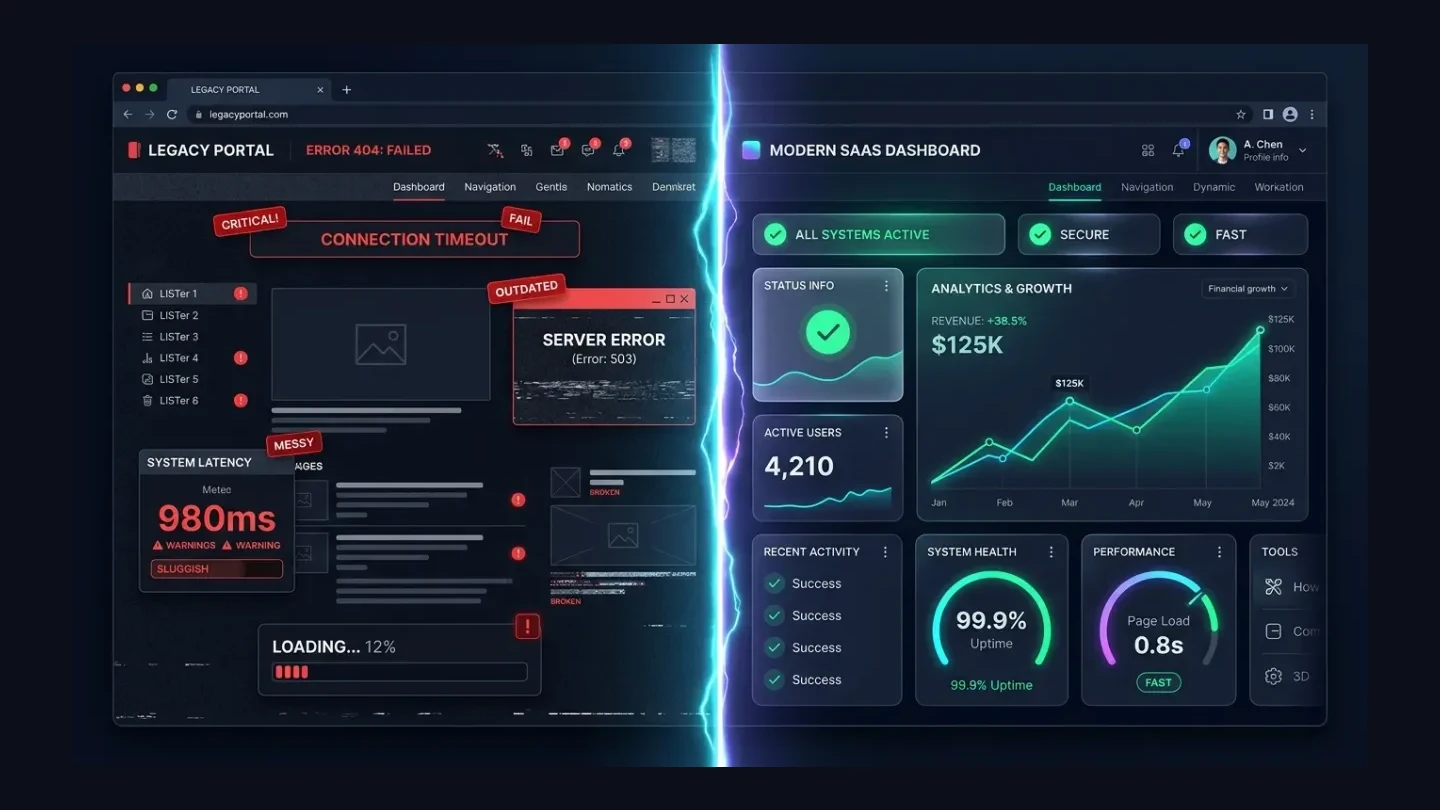
Page Builder Core + 35 Third-Party Plugins + Shared Hosting
  ➔ Constant Plugin Conflicts ➔ Sluggish Page Response (4s+) ➔ High Security Risk

[Modern Headless Architecture]
Next.js Frontend + Cloud APIs + Global Edge CDN
  ➔ Zero Plugin Dependencies ➔ Sub-Second Load Time (0.6s) ➔ Bank-Grade Security
The Fix
- Graduate to Custom Web Architecture: Transition your core web platform to a custom full-stack system built with Next.js web development and headless backend integrations.
- Decoupled Architecture: Keep your frontend user experience entirely separate from backend databases. This eliminates SQL injection risks and ensures your marketing site stays 100% online even during traffic spikes.
- Tailored Workflows: Build exact custom forms, admin dashboards, and dynamic features without paying recurring monthly subscription fees for dozens of buggy plugins.
5. Treating Mobile-First User Experience as an Afterthought
The Problem
Over 62% of global web traffic—and more than 75% of local commercial inquiries—now takes place on mobile devices. Despite this, many agencies still design websites exclusively on 27-inch desktop monitors, only shrinking elements down at the very end.
The result is a frustrating mobile experience:
- Text that requires pinching and zooming to read.
- Tiny buttons positioned too close together, leading to accidental misclicks.
- Sticky promotional popups or chat widgets that completely block the smartphone screen and cannot be closed.
- Tables and images that break horizontal layouts and trigger awkward sideways scrolling.
When a mobile user experiences any of these friction points, they bounce within 4 seconds. Google notes that users are 67% more likely to purchase from a mobile-friendly site and 5x more likely to abandon a non-optimized mobile experience.
The Fix
- Mobile-First CSS Engineering: Design every layout from a 375px viewport upwards. Ensure touch targets (buttons and links) are at least 48x48 pixels with ample white space.
- Responsive Font Scales: Use modern clamp-based fluid typography so headlines dynamically adjust between mobile screens, tablets, and wide desktop displays without awkward text wrapping.
- Test on Real Hardware: Never rely solely on browser inspect tool emulation. Test your site on actual iOS and Android devices across varying network speeds.
Summary: The 5-Point Website Health Checklist
Before you spend another dollar on paid Google Ads or social media marketing, run through this quick checklist:
- Speed: Does your site achieve a 90+ score on Google PageSpeed Insights and load under 2 seconds?
- Value Proposition: Can a first-time visitor understand what you do and who you serve within 5 seconds of landing on your homepage?
- Clear Next Step: Is there an unmissable, high-contrast Call-to-Action button visible without scrolling?
- Mobile Usability: Can a prospective buyer effortlessly navigate your site and complete your contact form with one thumb on a smartphone?
- Future-Proof Stack: Is your website built on modern, secure code that scales without relying on dozens of fragile plugins?
Ready to Turn Your Website into a High-Converting Sales Engine?
Stop letting preventable web design mistakes quietly drain your business growth. If your website is generating visitors but failing to deliver consistent, qualified leads, it's time to identify exactly what is holding you back.
At Joy Digital, we specialize in engineering lightning-fast, high-converting custom websites and data-driven SEO strategies for growing businesses.
👉 Claim Your Free Comprehensive Website Audit Report – Our senior technical engineers will thoroughly review your site's speed bottlenecks, Core Web Vitals, mobile UX, and conversion barriers—completely free of charge.
Or, if you are ready to build a high-performance web platform from the ground up, contact our team today to schedule a discovery consultation!
Recommended Services & Solutions
Frequently Asked Questions

Digital marketing strategist and Next.js web developer focusing on search optimization, Core Web Vitals, and B2B conversion rate growth.